
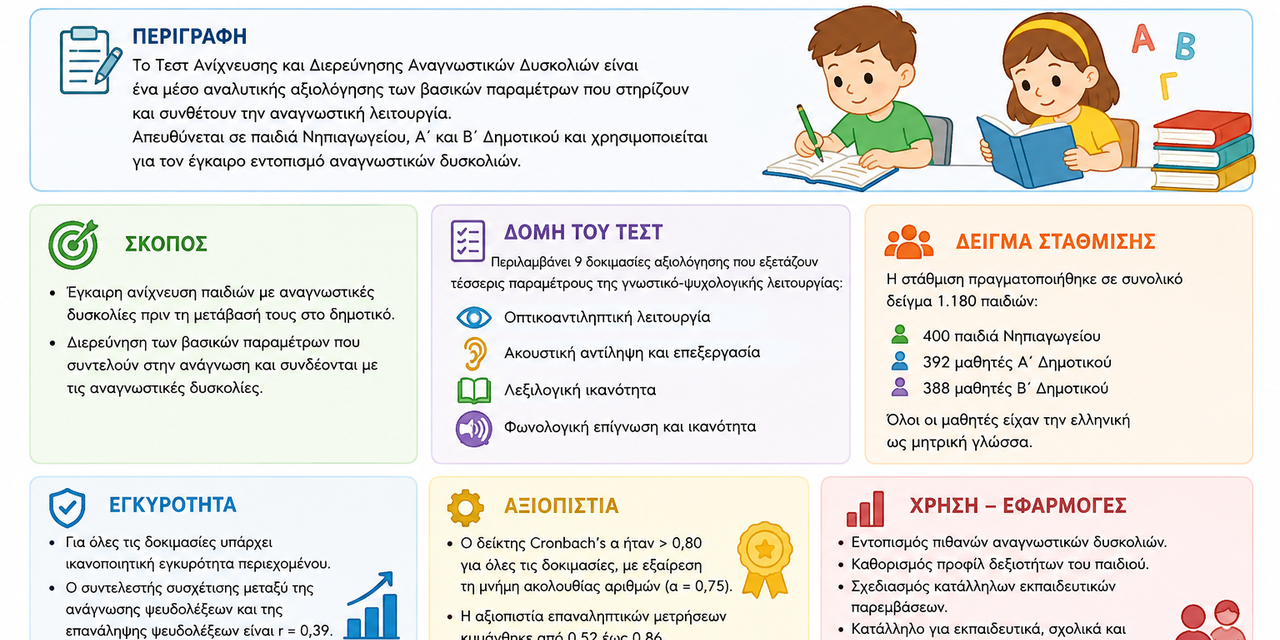
Description
The Screening and Investigation Test for Reading Difficulties is a structured assessment tool designed to evaluate the main cognitive and language-related components that support the development of reading ability.
It is intended for children in kindergarten, first grade, and second grade of primary school and is used for the early identification of difficulties that may affect the acquisition of reading skills.
Purpose
The primary purpose of the instrument is the early detection of children who experience reading difficulties, so that appropriate educational support and intervention can be provided as early as possible.
At the same time, the test aims to investigate the specific cognitive and linguistic functions that contribute to reading and may be associated with difficulties in reading development.
Structure
The test includes 9 assessment tasks, covering four major areas of cognitive and psychological functioning:
- Visual-perceptual functioning
- Auditory perception and processing
- Vocabulary ability
- Phonological awareness and ability
The tasks include activities such as copying, completing incomplete sentences, phoneme discrimination, segmenting words into syllables, and reading words and texts.
Standardization Sample
The instrument was standardized on a total sample of 1,180 children, distributed as follows:
- 400 kindergarten children
- 392 first-grade primary school students
- 388 second-grade primary school students
All participants had Greek as their native language.
Validity
The individual tasks demonstrated satisfactory content validity.
The correlation between the pseudoword reading task and the pseudoword repetition task was reported as r = 0.39, providing additional evidence regarding the relationship between related language-processing skills.
Reliability
Internal consistency was examined separately for each task and age group using Cronbach’s alpha.
For most tasks, coefficients were above 0.80, with the exception of the number-sequence memory task, for which the coefficient was 0.75.
Test-retest reliability coefficients ranged from 0.52 to 0.86, indicating variation in the temporal stability of the individual tasks.
Data Analysis and Use
The results may be used both for the identification of potential reading difficulties and for the development of a more detailed profile of each child’s underlying skills.
Performance across the individual tasks may help identify specific areas of difficulty, such as phonological processing, auditory discrimination, vocabulary ability, or visual-perceptual functioning.
Applications
The instrument may be used in educational, school, and special education settings for the early screening of reading difficulties and for planning appropriate support or intervention.
Its use is particularly relevant during the early stages of education, when early identification of difficulties may contribute to more effective support for subsequent reading development.
References
Porpodas, K. A. (2002). Reading. Patras: Self-published.
Porpodas, K. A. (2003). Learning and Its Difficulties: A Cognitive Approach. Patras: Self-published.
![Coping Orientation to Problems Experienced [COPE-60]](https://statistics.datanalysis.net/wp-content/uploads/2025/05/miscellaneous4-EN-650x400-250503-440x264.png)
![Community Adjustment Scale [CAS-12]](https://statistics.datanalysis.net/wp-content/uploads/2025/05/miscellaneous3-EN-650x400-250503-440x264.png)
![Revised Multigroup Ethnic Identity Measure [MEIM-R-15]](https://statistics.datanalysis.net/wp-content/uploads/2025/05/ethnicities2-EN-650x400-250503-440x264.png)
![High School Survey of Student Engagement [HSSSE-121]](https://statistics.datanalysis.net/wp-content/uploads/2025/04/academic2-EN-250418-650x400-1-440x264.png)

![Role Play Test [RPT-3]](https://statistics.datanalysis.net/wp-content/themes/Extra/images/post-format-icon-text.svg)
![Wisconsin Quality of Life Index for Adults Questionnaire [W-QLI]](https://statistics.datanalysis.net/wp-content/uploads/2025/05/life2-EN-650x400-250503-150x150.png)
![The Relationship Between Conflict, Communication, and Sex [AQ-68]](https://statistics.datanalysis.net/wp-content/uploads/2026/08/e135da0a-a8ab-47b6-9eb3-8f83a77a2469.png)